

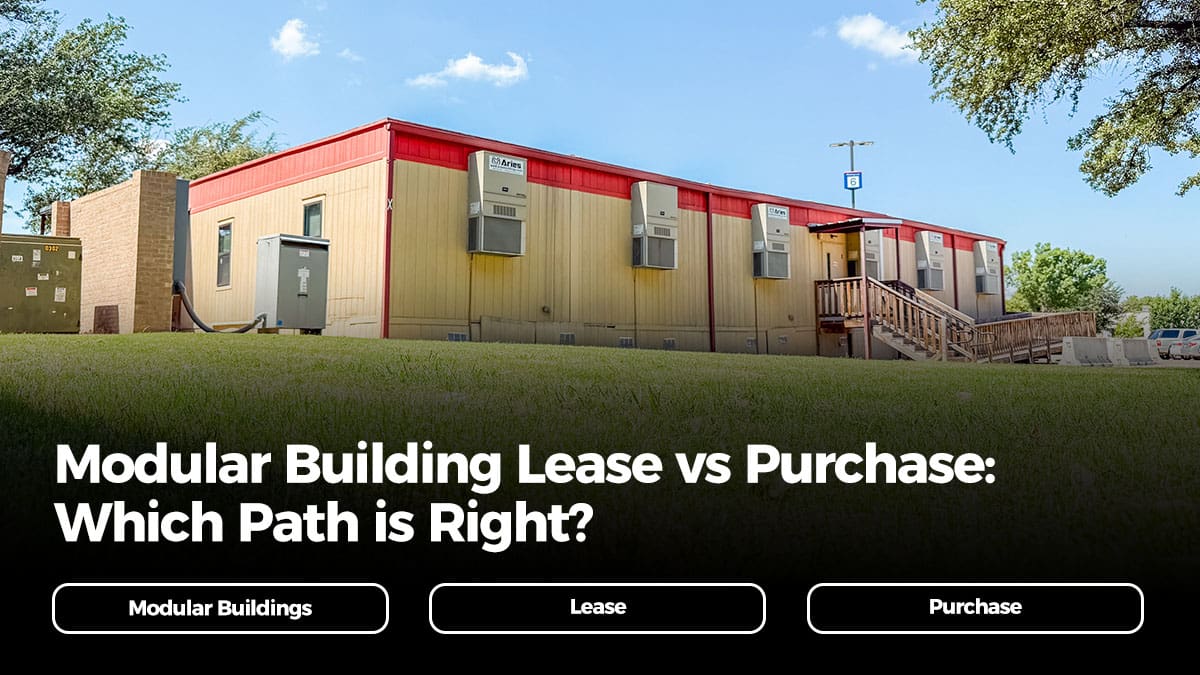
Is it better to lease or buy a modular building?
The short answer: it depends.
You need to consider your timeline, budget structure, and long-term plans.
In this modular building lease vs purchase guide, we break down the advantages, limits, and real-world use cases of either option so you can make a sound decision.
Why Asking the Question Matters
The modular building lease vs purchase decision is not simply a matter of space but more about strategy.
In the education, healthcare, and government sectors, space needs can change quickly. Enrollment climbs, patient volumes spike, programs expand, and funding cycles vary. A modular building can solve space problems efficiently, but the procurement path shapes how that solution fits into your budget and planning process.
School districts often face bond timelines and annual operating budgets. Healthcare systems may respond to seasonal surges or service line growth. Government agencies work within strict capital planning rules. In each case, leasing and purchasing affect approvals, accounting treatment, and long-term flexibility.
Choosing the right alternative can reduce delays, protect capital funds, and help you avoid overbuilding.
Leasing a Modular Building
Leasing is often the fastest way to add space. In the modular building lease vs purchase debate, leasing usually wins when speed and flexibility matter most. The benefits of leasing include:
- Lower upfront cost: Leasing spreads payments, so it helps when capital funds are limited or already committed.
- Ideal for short-term projects: If the space is needed for two to five years, leasing can be adjusted to align with that window.
- Easier approval in some public sectors: Operating expenses may move faster through approval channels than capital purchases.
- Flexibility to scale: You can add or remove units as your needs change.
In the following cases, the modular building lease vs purchase decision leans toward leasing because it reduces risk tied to demand uncertainty.
- School districts managing enrollment shifts often lease classrooms. If growth levels off, they won’t be locked into a long-term asset.
- Government agencies responding to temporary facility needs, such as disaster recovery or pilot programs, may prefer lease terms that match their project duration.
- Healthcare sites facing temporary capacity surges, renovation disruptions, or seasonal demand can deploy leased space without committing to permanent infrastructure.
Purchasing a Modular Building
Purchasing is about long-term ownership. In the modular building lease vs purchase comparison, buying often supports stable growth plans. Below are the benefits of purchasing:
- Long-term asset ownership: The building becomes part of your capital portfolio.
- More customization options: Purchased buildings can be designed to suit site and program needs, from clinical layouts to security features.
- Greater return over time: For long-use periods, ownership can cost less than extended lease payments.
- May qualify for capital improvement funding: Bonds or capital budgets often cover permanent expansions.
Purchasing a modular building is considered the smarter move in the following scenarios:
- Permanent campus expansions, specifically when a district knows enrollment will remain high, so buying supports long-term planning.
- Government agencies with stable growth projections may prefer ownership, as it aligns with multi-year capital improvement plans.
- Healthcare facilities with predictable long-term space needs, such as outpatient clinics or specialty units, may benefit from investing in a permanent modular solution.
The modular building lease vs purchase decision often favors ownership in the above cases because the space will serve for many years.
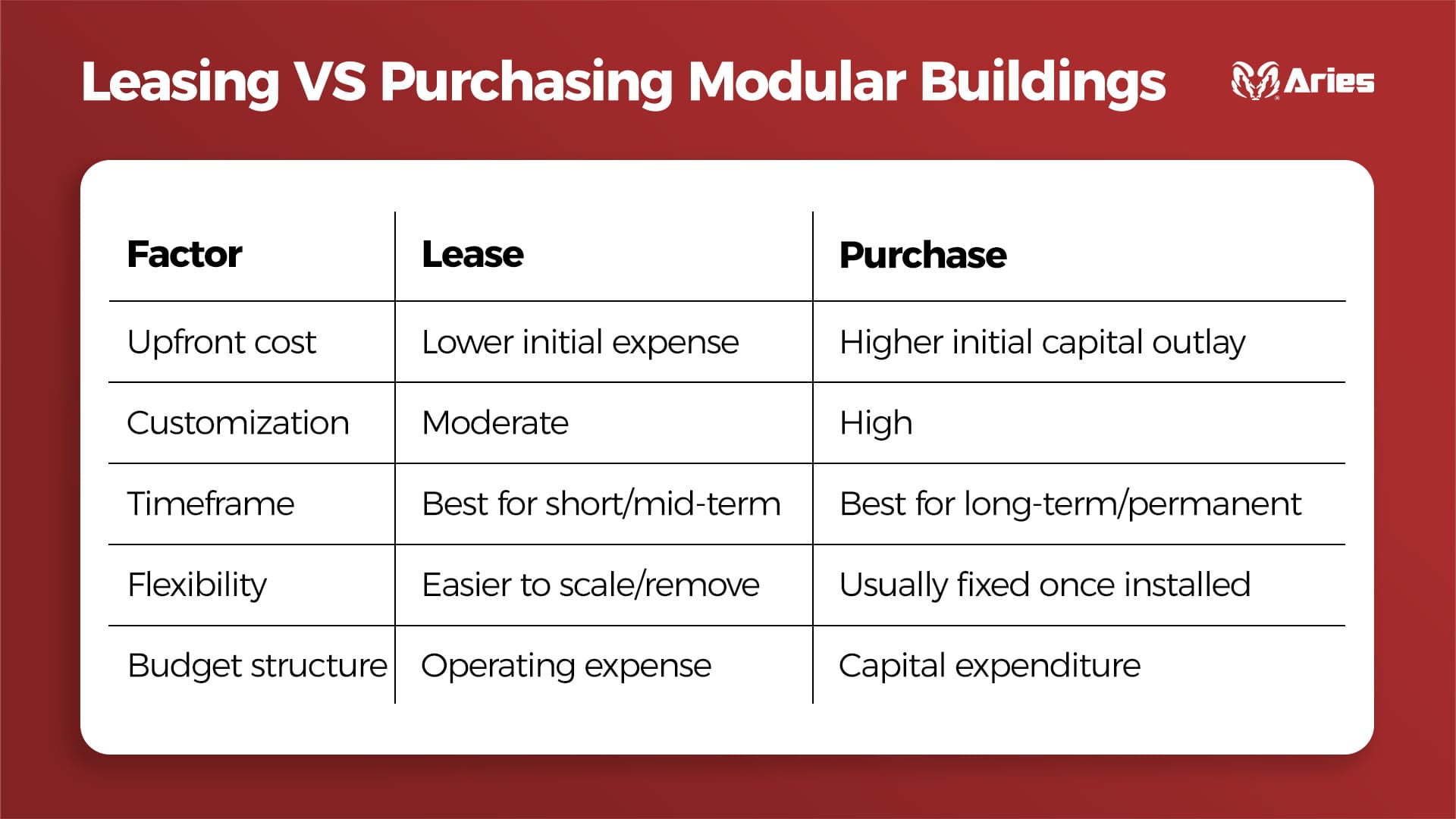
At-a-Glance Comparison Table
Below is a comparison table that helps frame the modular building lease vs purchase comparison in practical terms.
Mini Decision Checklist
When choosing between a modular building lease vs purchase, these questions are worth pondering:
- What is your intended timeline for using the space?
- Will your needs likely grow or change?
- Do you have funding in place for a capital purchase?
- Do you need rapid deployment?
If your timeline is short or uncertain, leasing often fits better. If the need is permanent and funded, purchasing may provide better long-term value.
But if you are still unsure, Aries can help you weigh your options and financing, and recommend the best path forward. Contact us today!
Is it better to lease or buy a modular building?
The short answer: it depends.
You need to consider your timeline, budget structure, and long-term plans.
In this modular building lease vs purchase guide, we break down the advantages, limits, and real-world use cases of either option so you can make a sound decision.
Why Asking the Question Matters
The modular building lease vs purchase decision is not simply a matter of space but more about strategy.
In the education, healthcare, and government sectors, space needs can change quickly. Enrollment climbs, patient volumes spike, programs expand, and funding cycles vary. A modular building can solve space problems efficiently, but the procurement path shapes how that solution fits into your budget and planning process.
School districts often face bond timelines and annual operating budgets. Healthcare systems may respond to seasonal surges or service line growth. Government agencies work within strict capital planning rules. In each case, leasing and purchasing affect approvals, accounting treatment, and long-term flexibility.
Choosing the right alternative can reduce delays, protect capital funds, and help you avoid overbuilding.
Leasing a Modular Building
Leasing is often the fastest way to add space. In the modular building lease vs purchase debate, leasing usually wins when speed and flexibility matter most. The benefits of leasing include:
- Lower upfront cost: Leasing spreads payments, so it helps when capital funds are limited or already committed.
- Ideal for short-term projects: If the space is needed for two to five years, leasing can be adjusted to align with that window.
- Easier approval in some public sectors: Operating expenses may move faster through approval channels than capital purchases.
- Flexibility to scale: You can add or remove units as your needs change.
In the following cases, the modular building lease vs purchase decision leans toward leasing because it reduces risk tied to demand uncertainty.
- School districts managing enrollment shifts often lease classrooms. If growth levels off, they won’t be locked into a long-term asset.
- Government agencies responding to temporary facility needs, such as disaster recovery or pilot programs, may prefer lease terms that match their project duration.
- Healthcare sites facing temporary capacity surges, renovation disruptions, or seasonal demand can deploy leased space without committing to permanent infrastructure.
Purchasing a Modular Building
Purchasing is about long-term ownership. In the modular building lease vs purchase comparison, buying often supports stable growth plans. Below are the benefits of purchasing:
- Long-term asset ownership: The building becomes part of your capital portfolio.
- More customization options: Purchased buildings can be designed to suit site and program needs, from clinical layouts to security features.
- Greater return over time: For long-use periods, ownership can cost less than extended lease payments.
- May qualify for capital improvement funding: Bonds or capital budgets often cover permanent expansions.
Purchasing a modular building is considered the smarter move in the following scenarios:
- Permanent campus expansions, specifically when a district knows enrollment will remain high, so buying supports long-term planning.
- Government agencies with stable growth projections may prefer ownership, as it aligns with multi-year capital improvement plans.
- Healthcare facilities with predictable long-term space needs, such as outpatient clinics or specialty units, may benefit from investing in a permanent modular solution.
The modular building lease vs purchase decision often favors ownership in the above cases because the space will serve for many years.
At-a-Glance Comparison Table
Below is a comparison table that helps frame the modular building lease vs purchase comparison in practical terms.
Mini Decision Checklist
When choosing between a modular building lease vs purchase, these questions are worth pondering:
- What is your intended timeline for using the space?
- Will your needs likely grow or change?
- Do you have funding in place for a capital purchase?
- Do you need rapid deployment?
If your timeline is short or uncertain, leasing often fits better. If the need is permanent and funded, purchasing may provide better long-term value.
But if you are still unsure, Aries can help you weigh your options and financing, and recommend the best path forward. Contact us today!
READ MORE


Follow Us On Social Media!